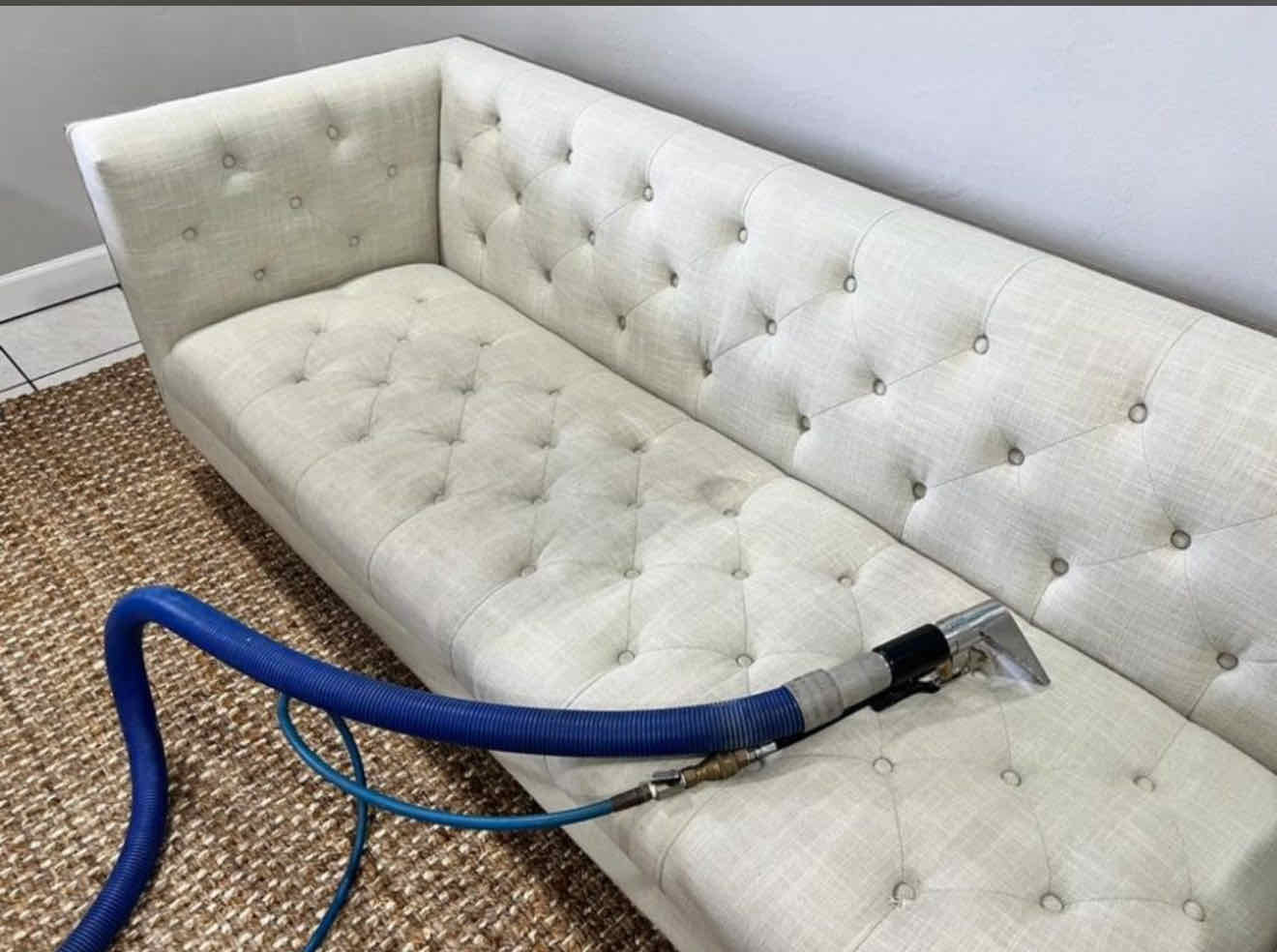
Most calls about white furniture start the same way. Someone looks at a sofa they bought a couple of years ago, then looks at the color it is now, and the gap between the two is what makes them pick up the phone.
Here is the thing worth knowing before you decide the piece is ruined. A white sofa that stopped looking white is almost always soiled rather than aged. White does not hide anything, so it shows the same dirt a gray or patterned couch has been quietly carrying the whole time.
Why white shows everything
Colored and patterned fabric has cover. A charcoal sectional can hold years of body oil and foot traffic and still look presentable, because the soil blends into a dark base and the pattern breaks up any marks.
White has none of that. Every oil mark on the armrest, every place a pet climbed up, every spot where dark jeans rubbed the seat and left a faint blue cast, all of it lands on a surface with nowhere to disappear. That is the fabric being honest about a load every couch carries, and the white simply refuses to hide it.
How white goes gray and yellow
Two things are happening at once, and neither one announces itself.
The first is body oil. Skin and hair leave oil on the high-contact zones, the armrests, the headrests, the front edge of the seat cushions. Fresh oil is close to invisible on white. Over months it oxidizes, and oxidized oil turns yellow. That is the warm, dingy tone you see creeping into the arms and the top of the back cushions first.
The second is everyday soil. Dust, skin cells, and fine grit from the air settle into the fibers across the whole surface at once. Because it builds evenly, there is no line to alert you. The couch just drifts from white toward gray a little at a time, the way you never notice your own kid growing until a relative visits. Most people only see how far it went when we clean a test patch and the cleaned square sits next to the original.
What extraction does for light fabric
The method is hot water extraction, what most people call steam cleaning. We push heated water and cleaning solution into the fabric to lift the oil and soil off the fibers, then a strong vacuum pulls it back out along with the dirt. On white upholstery that extraction step matters more than anywhere, because a surface scrub just moves a gray film around. You have to pull the load out of the couch instead of pushing it from one spot to another.
Before any of that, we test. On white and light fabric we check the fiber type and the dye stability at a small sample area first, because some light fabrics are more reactive than they look and a few will brown or shift if they are cleaned wrong. That sample also tells you the honest ceiling. Deep denim transfer that has set for a year, or a spot that has been scrubbed with the wrong product at home, may not come all the way back. You see the real result on your own couch before we commit to the full piece.
If you are wondering how far to space these cleanings out, we walked through that in our guide on how often upholstery needs professional cleaning. White and light fabric generally wants the shorter end of any range, simply because it shows soil sooner than dark fabric hiding the same amount.
Protection buys white furniture time
Cleaning resets the couch. Fabric protection is what keeps it reset longer.
A protector coats each fiber so liquids bead up instead of soaking straight in, and dry soil sits on the surface where a vacuum can reach it. On a white sofa that head start is the whole game. When someone knocks over a glass of red wine, an unprotected white cushion drinks it in seconds and you are into stain territory. A protected cushion gives you time to grab a towel and blot before it sets. A protector is a head start. It will not make the fabric spill-proof, and you still owe the couch a real deep clean on a schedule. What it buys you is time, and on light fabric time is the difference between a blot and a permanent mark.
When cleaning cannot bring it back
We will not sell you a clean that cannot deliver. Some yellowing has nothing to do with soil. It is the fiber itself aging, or a section that has faded and gone warm from sitting in Florida sun by a window for years. No cleaning reverses fiber aging or sun damage, and anyone who tells you otherwise on a white couch is guessing.
This is exactly what the sample area is for. If the discoloration lifts on the test patch, your couch is dirty and we can help. If it does not move, the color has changed in the fiber, and we would rather tell you that on day one than take your money for a result we already know is not coming.
Get your white furniture looking white again
If you have a white or light sofa that has drifted gray or yellow, the fastest way to know what is recoverable is to let us clean a sample spot. Reach out for a free quote, and on arrival we will test a hidden area so you see exactly how much of that brightness comes back before we clean the whole piece.
Frequently asked questions
Are you dealing with a white sofa that doesn't look white anymore?
Most of the time the fabric is soiled rather than worn out. Body oils, everyday dust, and dye transfer build up evenly across the surface, so white slowly reads as gray or cream. Hot water extraction pulls that film out and usually brings the brightness back.
Why does white upholstery turn gray or yellow over time?
Body oils from skin and hair oxidize on the fabric and go yellow, while airborne dust and soil settle into the fibers and read as gray. Because it builds evenly, you rarely notice until you compare a cleaned patch to a hidden seam.
Can you get body oil and jean dye off a white armrest?
In many cases, yes. Armrests and headrests are the highest-contact spots, so they hold the most oil, and denim dye transfer is one of the most common marks we see on light seats. Some deep or old transfers do not lift completely, and we tell you that at the sample stage.
Is the yellowing on my white couch permanent?
Sometimes. If the yellow is trapped soil and oil, cleaning removes it. If the fiber itself has aged or faded from sun exposure, no cleaning reverses that, and we would rather tell you honestly at the sample area than have you pay for a result we cannot deliver.
Does fabric protection help keep a white sofa clean longer?
Yes. A fabric protector coats the fibers so spills bead up and soil sits on top instead of soaking in, which buys white furniture real time between deep cleans. It does not make the sofa spill-proof, but it gives you a window to blot before a stain sets.